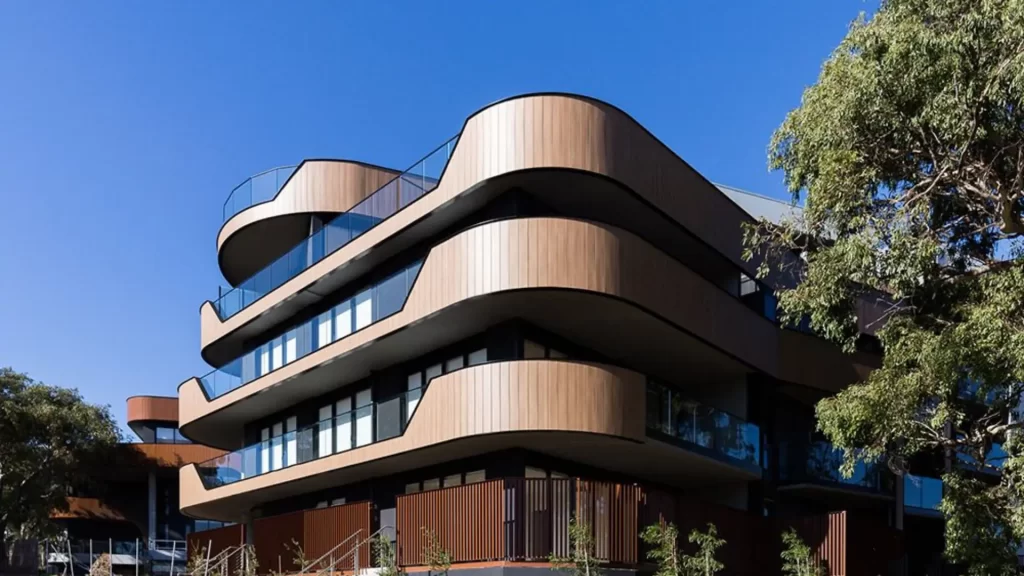
Have you ever wondered how aluminum cladding panels get that stunningly realistic wood finish? The magic behind it is a process called wood grain thermal transfer printing. It’s a sophisticated technique that creates a durable, beautiful wood aesthetic on materials like aluminum, steel, and MDF.

The Foundation: Process at a Glance
Before we dive deep, let’s look at the key parameters that define a high-quality wood grain transfer process.
| Parameter | Specification |
| Applicable Materials | Metal Substrates (Aluminum Alloy, Galvanized Steel), Panel Substrates (MDF, Particle Board) |
| Quality Goals | Clear wood grain texture (≥95% fidelity), strong adhesion (≥4B on cross-cut test), excellent weather resistance (no fading after 500h UV exposure) |
| Core Equipment | Pre-treatment tanks, powder coating equipment, thermal transfer machine (vacuum/roller), finishing sanders |
| Key Materials | Degreaser, phosphating solution (for metal), thermosetting powder coating, wood grain transfer paper (PET film, 40-60μm), release agent |
| Environment | Temperature: 20-25°C, Humidity: 40%-60%, Dust-free workshop (dust concentration ≤0.1mg/m³) |
| Production Cycle | A single batch of 100 pieces (1200×600mm) takes approximately 8 hours. |
Stage 1: Meticulous Substrate Pre-treatment
You can’t build a great house on a weak foundation. Similarly, a perfect wood grain finish starts with flawlessly prepared material. The steps differ slightly for metal and wood-based panels.
For Metal Substrates (e.g., Aluminum Alloy)
- Degreasing: The metal is submerged in a degreasing agent (5%-8% concentration) at 45-50°C for 15-20 minutes to remove all machine oil and fingerprints. A successful degreasing leaves a continuous water film on the surface.
- Rinsing: The part is rinsed twice with clean, room-temperature water for 3 minutes each time to remove any residual degreaser.
- Phosphating: The metal is then placed in a phosphating solution (10%-12% concentration) at 35-40°C for 10-12 minutes. This creates a microscopic phosphate film (3-5μm thick) that dramatically improves corrosion resistance and paint adhesion.
- Drying: Finally, the substrate is dried in an oven at 80-90°C for 20 minutes until its moisture content is below 1%.
For Panel Substrates (e.g., MDF)
- Sanding: The panel surface is sanded with 180-grit sandpaper to remove burrs and scratches, ensuring the surface is perfectly flat (tolerance ≤0.2mm/2m).
- Dust Removal: High-pressure air (0.5-0.6MPa) followed by a tack cloth is used to completely remove all sanding dust.
- Sealing: A transparent sealer is applied and cured in an oven at 60-70°C for 30 minutes. This closes the pores of the material, preventing it from absorbing moisture and warping later.
Applying the Base Coat
After cleaning and preparation, a base coat is applied. This is the color layer that will show through the “darker” parts of the wood grain.
- Metal: An epoxy-polyester powder coat (60-80μm thick) is electrostatically applied and cured at 180-200°C for 15-20 minutes.
- Panels: A water-based primer (30-40μm thick) is roller-coated and dried at 70-80°C for 40 minutes.

Stage 2: The Core Thermal Transfer Process ✨
This is where the transformation happens. The wood grain pattern, printed on a special PET film, is transferred onto the base-coated substrate using heat and pressure.
1. Applying the Transfer Paper
The wood grain transfer paper is cut to the size of the substrate, leaving a small 5-10mm border. The printed side is placed firmly against the base coat and secured with high-temperature tape. For curved or complex shapes, a heat gun is used to help the paper conform to the substrate’s contours.
2. Heat Transfer Operation
There are two main types of machines used for this step:
Vacuum Thermal Transfer Machine (for flat or shaped parts):
- The part is placed in the machine, and a vacuum pump creates strong negative pressure (≤-0.09MPa) to ensure the transfer paper is in perfect, airtight contact with the substrate.
- The machine heats up to 160-180°C. The process takes 20-25 minutes under 0.3-0.5MPa of pressure.
- After the cycle, the part is cooled below 60°C, and the transfer paper is peeled away, leaving the wood grain ink sublimated onto the base coat.
Roller-Type Thermal Transfer Machine (for long profiles like extrusions):
- The paper-wrapped profile is fed between heated rollers (170-175°C) at a speed of 1.5-2 m/min.
- The pressure from the rollers (0.4MPa) instantly transfers the pattern as the profile moves through.
- The paper is peeled off immediately as the profile exits the machine.
3. Initial Quality Check
Right after the paper is removed, a quick inspection is done to check for:
- Completeness: No missing spots or breaks in the grain.
- Color: The color is uniform and matches the reference sample (color difference ΔE ≤1.5).
- Defects: No bubbles or wrinkles.
Stage 3: Finishing and Final Inspection
The part looks great, but it’s not done yet. A final finishing and coating step ensures it will last for years.
Surface Finishing
- Sanding: The edges are lightly sanded with 400-grit sandpaper to remove any roughness from the paper’s border.
- Cleaning: The surface is blown with high-pressure air and wiped with alcohol to remove any dust, oil, or fingerprints before the final topcoat.
Applying the Protective Topcoat
A transparent topcoat is applied to protect the wood grain pattern from scratches, UV rays, and weather.
- Metal: A high-durability fluorocarbon clear coat is used.
- Panels: A polyurethane clear coat is applied. The topcoat is cured in an oven, resulting in a hard, durable finish (hardness ≥3H) with excellent adhesion (≥4B).
Final Quality Control
Every batch undergoes rigorous testing to ensure it meets quality standards.
| Test Item | Method | Acceptance Standard |
| Wood Grain Fidelity | Visual comparison & colorimeter | ≥95% pattern accuracy, color difference ΔE ≤1.5 |
| Adhesion | Cross-Cut Test (GB/T 9286-1998) | ≤5% coating loss after test (4B grade) |
| Weather Resistance | UV Aging Test (GB/T 1865-2009) | After 500h, ΔE ≤3.0, no cracking |
| Abrasion Resistance | Abrasion tester (500g load, 1000 cycles) | No exposure of substrate, gloss change ≤10% |
Troubleshooting Common Problems
Even in a well-controlled process, issues can arise. Here’s a quick guide to fixing common problems.
| Problem | Common Causes | Solution & Prevention |
| Bubbles After Transfer | 1. Insufficient vacuum. 2. Air trapped under the paper. 3. Uneven substrate surface. | Solution: Re-vacuum the part or prick the bubble to release air and re-apply heat/pressure. Prevention: Ensure the vacuum pump is working correctly and smooth the paper from the center outwards during application. |
| Blurry or Faded Grain | 1. Temperature is too low. 2. Transfer time is too short. 3. Low-quality transfer paper. | Solution: Increase temperature/time. Replace the transfer paper. Prevention: Regularly calibrate machine temperature sensors and source high-quality paper with good ink adhesion. |
| Poor Coating Adhesion | 1. Incomplete degreasing (oil on surface). 2. Base coat was not fully cured. 3. Topcoat is incompatible with the transfer layer. | Solution: The part must be stripped and re-processed from the pre-treatment stage. Prevention: Verify degreasing with a water-break test. Calibrate oven temperatures. Test topcoat compatibility beforehand. |
| Warping (Panel Substrates) | 1. Transfer temperature is too high. 2. High moisture content in the panel. 3. Cooled down too quickly. | Solution: Salvage may not be possible. Prevention: Use a lower transfer temperature (160-165°C) for panels. Ensure panels are properly dried (moisture ≤1%). Use a controlled, slower cooling cycle. |
Turn Theory into a Masterpiece: Partner with XtraMetal
Understanding the complex process of wood grain thermal transfer is one thing; transforming it into a stunning architectural reality is another. It requires experience, precision, and a relentless pursuit of excellence—qualities XtraMetal has honed for over 32 years.
As a global leader in aluminum facade and louver systems serving over 100 countries, we don’t just manufacture products; we create architectural “art pieces”. Our expertise has brought landmark hotels, stadiums, and shopping centers to life around the world.
Let your next project benefit from our one-stop service—from free design concepts to custom manufacturing and global delivery, we manage the entire process for you.