
The Wood Look Paradox: Why Timber Beauty Fails in Australian Weather
Timber look aluminium cladding exists because real timber fails in Australian weather. Under high UV, moisture and salt spray, a hardwood facade fades to grey, warps at the joins and needs restaining every year or two. A wood grain aluminium finish delivers the same warmth without that maintenance bill, which is what this guide walks through.

In Australia’s high-UV climate, a low-grade timber-look coating can fade from warm wood tones to grey within two years, and a real timber facade demands restaining every one to two years to stay presentable. A quality wood grain aluminium cladding system solves this by fusing the grain into a powder-coated aluminium substrate, so the finish cannot warp, rot or attract termites. That is why Australian specifiers keep moving from painted timber to wood grain aluminium for exterior walls.
The fear is not hypothetical. Projects within five kilometres of the coast add salt spray on top of the UV load, and a powder coat without proper UV protection is exactly what turns pink or grey two summers in. The decision is therefore not timber versus metal. It is whether the metal finish is engineered for the site, and the rest of this guide breaks that down dimension by dimension.
What Is Timber Look Aluminium Cladding (And How the Wood Grain Is Made)
Timber look aluminium cladding is an extruded or formed aluminium wall system finished with a wood grain pattern. It covers facades, battens and soffits with the warmth of timber while the metal underneath never rots, warps or needs painting. The grain is applied in a two-stage process, a powder base coat followed by heat transfer.

There are three common ways to put a wood look on aluminium, and they are not equal:
- Sublimación de vetas de madera (heat transfer): a powder base coat is applied first, then a grain pattern film is transferred into that layer under heat and vacuum. This produces the most realistic grain and the most durable bond.
- Timber veneer wrap: a thin real-wood veneer is bonded to the aluminium face. It looks authentic up close but the surface is still wood, so it fades and needs maintenance, and it is often made overseas with a shorter warranty.
- Wood-effect powder coat: a single powder layer printed with a wood tone. It is durable and cheap but the grain lacks depth, reading as a flat colour from a few metres away.
The honest way to think about the three is realism versus durability. Sublimation wins on both. A deeper look at the base system helps here, ver paneles de revestimiento de metal y el types of metal cladding for the underlying product range.
A true wood grain finish on aluminium is applied in two stages. First the panel receives a powder coat in the wood’s background tone, then a grain pattern is transferred into that layer using heat and vacuum, followed by a clear fluorocarbon top coat. Veneer and single-layer powder alternatives exist, but one keeps a real wood surface that still fades and the other lacks the depth of a genuine grain. When a client asks how close it looks to real timber, the answer depends on which of these three processes the supplier actually uses.
Wood Look vs Real Timber: A Full-Dimension Comparison
Over a 20-year life cycle, wood grain aluminium cladding costs less than real timber once you account for maintenance. Timber wins only on the initial material price. Aluminium wins on every recurring cost after installation, which is why the comparison matters more than the upfront quote.

| Dimensión | Real timber cladding | Wood grain aluminium cladding |
|---|---|---|
| Costo inicial | Más bajo | Más alto |
| Mantenimiento | Restain every 1 a 2 años | Ninguno |
| Desgaste | Fades, warps, splits, rots | UV stable, dimensionally stable |
| Fuego | Combustible | COMO 1530.1 incombustible |
| Termitas | Vulnerable | Immune |
| Life cycle | 10 a 20 years with upkeep | 15-año de garantía de desvanecimiento |
| Mano de obra | Ongoing, $55 to $80/hr | Install once |
The labour line is where the total cost of ownership turns. A skilled crew bills $55 a $80 una hora, and restaining a timber facade every two years compounds that cost across the building’s life. The comparison is covered in more depth for battens specifically in aluminium battens vs wood battens.
Real timber cladding is usually cheaper to buy and more expensive to own. A skilled crew bills $55 a $80 an hour in Australia, and a timber facade needs restaining every one to two years, so maintenance alone can overtake the aluminium price difference within the first decade. Wood grain aluminium cladding installs once, needs no repainting, cannot rot or be eaten by termites, and carries a 15-year fade warranty on the coating.
Inside the Sublimation Process: The 180°C Wood Grain Transfer
The wood grain on quality aluminium cladding is not painted on, it is transferred under heat and vacuum. A grain pattern film is fused into a powder-coated panel at 160 a 180°C, bonding the ink into the coating itself. This is why the pattern will not peel the way a stick-on film does.

The process parameters are what separate a factory that knows the process from one that only claims the word “sublimation”:
- Temperatura: 160 a 180°C, with 180°C for metal substrates and 160°C for panel substrates
- Vacío: 0.09 MPa o inferior
- Dwell time: 20 a 25 minutes under heat and pressure, longer for a 60-micron transfer film than a 40-micron film
- Roller line (alternative): 170 to 175°C drum temperature at 1.5 a 2 metres per minute, con 15 a 18 seconds of contact
Quality control on this process comes down to three failure modes, each with a known cause:
- Bubbles under the grain: vacuum not deep enough or the film not seated, fixed by controlling vacuum at 0.09 MPa or below.
- Blurred grain: temperature or dwell time too low, fixed by holding the 20 a 25 minute window.
- Poor adhesion: base coat not fully cured, caught in cross-cut adhesion testing at a 4B rating.
Vacuum heat transfer fuses the wood grain into the coating at 160 to 180°C under a vacuum of 0.09 MPa o inferior, holding temperature and pressure for 20 a 25 minutos. This is what separates a bonded grain from a printed or wrapped surface: the pattern sits inside the finish, not on top of it. Three defects define poor work, namely bubbles, blurred grain and weak adhesion, and each traces back to vacuum, dwell time or base-coat curing.
Does Wood Look Aluminium Cladding Fade? UV Resistance Explained
Wood look aluminium cladding can fade if the coating is cheap, but a properly finished panel is engineered not to. The wood grain finish is tested to 500 hours of accelerated UV ageing with a colour shift of no more than 3.0 ΔE, well inside the threshold where the human eye notices a change.

The numbers behind the claim:
- 500 hours of accelerated UV ageing, with colour shift held to 3.0 ΔE or less and no cracking
- Wood grain reproduction accuracy of 95% o más alto, with colour deviation of 1.5 ΔE or less
- Cross-cut adhesion tested to a 4B rating
That test data is why a supplier can offer a 15-year warranty on the timber grain powder coating and fade resistance. The grain is fused into the coating, so it does not sit on the surface where UV can lift it. For the coating chemistry behind this, ver aluminium coatings.
Fade resistance is measurable, not a marketing promise. A quality wood grain aluminium finish is tested under accelerated UV ageing for 500 hours and must hold colour shift to 3.0 ΔE or less with no cracking, and hold a 4B rating in cross-cut adhesion testing. The supplier backs the timber grain powder coating with a 15-year fade warranty, because the grain is fused into the coating rather than sitting on the surface where sunlight can lift it.
Weather Resistance Beyond UV: Humedad, Salt Spray and Coastal Use
UV is only one failure mode. Humedad, salt spray and corrosion matter just as much for coastal projects, and this is where the aluminium alloy and the top coat choice decide the result. AA 6063 aluminium with an anti-corrosive coating rated for UV and marine exposure handles sites within five kilometres of the coast.
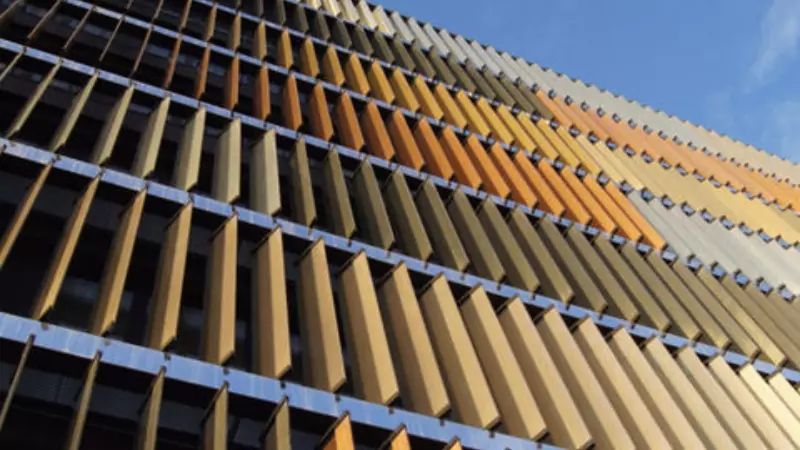
Coating choice is the single biggest lever, and the options map to the site:
| Revestimiento | Desgaste | High-salt coastal | Uso típico |
|---|---|---|---|
| capa de polvo (PPC) | Enhanced UV protection | Evaluate per site | Standard inland projects |
| Fluorocarbono PVDF | Resists UV, chemicals and corrosion | Preferred | Exterior costero y de alta gama |
| Wood grain sublimation | 500h UV tested, ΔE ≤ 3.0 | Specify with fluorocarbon top coat | Fachadas con aspecto de madera |
The right question to ask, and one customers do ask, is whether a timber-look panel can sit beside the ocean or even on a dock. With the right substrate and top coat the answer is yes, and the spec is what matters, not the pattern. A related product deep dive is powder coated aluminium cladding.
For coastal sites within five kilometres of the ocean, salt spray is the real threat, not just sunlight. The substrate should be AA 6063 aluminium with a corrosion-protective coating, and for high-salt exposure a fluorocarbon PVDF finish is the standard choice over powder coat because it resists UV, chemicals and marine corrosion. Customers ask whether a timber-look panel can sit beside the ocean on a dock; with the right coating spec, it can.
Cumplimiento: COMO 1530.1 Non-Combustibility and NCC 2025
For commercial and multi-storey facades, timber look aluminium cladding passes the non-combustibility test AS 1530.1 where real timber fails. ICONA 2025 then adds a second layer of requirement around condensation, which changes how the cladding must be detailed behind the panel.

The aluminium itself is the compliance asset. AA 6063 aluminium with a powder coat finished to an enhanced UV specification is compliant with AS 1530.1 for non-combustibility, which is the baseline for facades over three storeys. The article states compliance only; the test report itself is a separate document to request from the supplier.
ICONA 2025 strengthens condensation management for external walls in two ways:
- Part F8 (Volume One) y Parte 10.8 (Housing Provisions) expand the condensation provisions
- Climate zones 6, 7 y 8 now mandate a drained and ventilated cavity behind external cladding, so direct-fix cladding no longer meets the code in those zones
- Climate zones 1 y 3 are brought into condensation provisions for the first time
This plays to aluminium’s strength. A timber-look aluminium system is installed as a rainscreen over a ventilated cavity, which is exactly the detail NCC 2025 asks for, so a spec that was once optional is now the compliant default.
Compliance for a timber-look facade now has two parts. The finish must be non-combustible to AS 1530.1, which aluminium meets and timber does not, and under NCC 2025 the wall must manage condensation. El 2025 code mandates a drained and ventilated cavity behind external cladding in climate zones 6, 7 y 8, and brings zones 1 y 3 into the provisions for the first time. Aluminium cladding is built for exactly this, installed as a rainscreen over a ventilated cavity.
Installation and the Real Cost: Labour vs Material
The material is rarely the expensive part. In Australia labour runs $55 a $80 an hour and is often two to three times the material cost, so an install-friendly system saves more money than a cheaper panel. Thermal movement is the detail most guides miss, because aluminium expands and contracts and the panel needs room to move.

Two details decide whether a timber-look aluminium facade stays flat and leak-free:
- Expansion allowance: exterior aluminium panels need a 10 a 15 mm gap for thermal movement, and this gap is a design feature, not a defect
- Endurecimiento: panels above 600 por 800 mm need stiffening ribs spaced 550 a 600 mm to hold flatness
Fixings matter too. A click-on or concealed fixing system goes up faster than face-fixed screws and hides the fasteners for a cleaner timber look. The wider batten conversation, including sizes and spacing, is in the guía de selección de listones de aluminio.
Thermal expansion is where timber-look aluminium facades fail when the detail is wrong. Aluminium moves with temperature, so an exterior panel needs a 10 a 15 mm expansion allowance, and large panels above 600 por 800 mm need stiffening ribs spaced 550 a 600 mm to stay flat. Get these two details right and a click-on aluminium system goes up fast, which matters when labour is $55 a $80 an hour and often two to three times the material cost.
Choosing the Right Timber Look Cladding: Perfiles, Finishes and Warranty
Choose the profile, the finish and the warranty before you choose the price. A 15-year fade warranty means the supplier is standing behind the coating, and the profile and fixing method decide both the look and the install cost. Match each to the site, inland, coastal or bushfire.
Work through the list in this order:
- Profile: solid panels for a clean wall, battens for texture and screening, slats for sun control
- Finalizar: woodgrain sublimation for the most realistic timber look, powder coat for a simpler durable finish
- Garantía: confirm the 15-year fade warranty on the timber grain coating in writing
- Fijación: concealed or click-on to hold labour down and keep the facade clean
- Site conditions: coastal needs a fluorocarbon top coat, y NCC 2025 zones 6 a 8 need the ventilated cavity
When the spec is locked, the product pages are where the trade-off becomes concrete, starting with aluminium wood look cladding.
Specify the warranty before the price. A supplier that offers a 15-year fade warranty on the timber grain finish is standing behind the coating, and that single clause filters out the low-grade alternatives. Then match the profile to the site, solid panels for a clean wall, battens for texture and screening, and a concealed or click-on fixing system to keep the install fast and the labour bill down.
Frequently Asked Questions About Timber Look Aluminium Cladding
What is timber look cladding and what are its benefits?
It is an aluminium wall system finished with a wood grain pattern, giving the warmth of timber without the rot, urdimbre, repainting or termite risk of real wood.
How does aluminium timber look cladding compare to traditional timber?
Timber is cheaper to buy but needs restaining every one to two years, while aluminium costs more upfront and then requires no maintenance, so aluminium wins on total cost of ownership.
Does wood look aluminium cladding fade in the sun?
A quality finish holds 500 hours of accelerated UV ageing to 3.0 ΔE or less and carries a 15-year fade warranty. Cheap coatings fade to grey within two years.
How long does aluminium timber look cladding last?
The aluminium substrate lasts decades, and the timber grain coating is warrantied for 15 years against fading.
Is aluminium timber look cladding low maintenance?
Sí. There is no painting, sealing or staining, only occasional washing to keep the finish clean.
Can timber look aluminium cladding be used near the ocean?
Sí, with the right spec: AA 6063 aluminium and a fluorocarbon PVDF top coat for high-salt coastal exposure.
Does timber look aluminium cladding pass AS 1530.1 for high-rise buildings?
Sí. Aluminium is compliant with AS 1530.1 for non-combustibility, which real timber is not.
Is wood look aluminium cladding worth the extra cost vs real timber?
Para paredes exteriores, Sí. The maintenance savings at $55 a $80 an hour recover the upfront difference within the first decade.
What is the difference between wood veneer and powder coat wood look aluminium?
Veneer is a real wood skin that still fades and needs care, while a powder-coated or sublimated finish is fused into the aluminium and needs none.
Does timber look aluminium cladding need expansion gaps?
Sí. Exterior panels need a 10 a 15 mm gap for thermal movement, and large panels need stiffening ribs to stay flat.
Ready to Spec a Timber Look Facade?
Send your project details and we will match the profile, finish and warranty to your site, inland, coastal or bushfire. Request a quote
Artículos relacionados
- ¿Qué son los paneles de revestimiento de metal??
- Listones de aluminio versus listones de madera
- Coatings for Aluminum
- Metal Cladding Panels Exterior Ideas
- The Different Types of Metal Cladding
Productos recomendados
- Revestimiento de la madera de aluminio: the flagship timber-look panel system with a 15-year fade warranty.
- Listones de aspecto de madera de aluminio: timber-look battens for texture, screening and facade feature walls.
- Timbero externo Look Batten Cladding: batten cladding built for exterior weather exposure.
- Aluminium Wood Effect Cladding: a wood-effect finish for walls that want timber warmth at lower cost.
- Listones de aspecto de madera de aluminio: wood look slats for shading, screening and soffit detail.
- Listones de grano de madera de aluminio: fine wood grain slats where the grain detail matters up close.